
Quick Answer: Commercial flat roof maintenance means scheduled inspections, drainage checks, and seam repairs that catch damage early. Massachusetts property owners should inspect flat roofs at least twice yearly, clear drains regularly, and address ponding water within 48 hours to avoid costly membrane failure and premature replacement.
A single afternoon of ignored ponding water can turn a $400 membrane patch into a $40,000 emergency replacement. That is the reality facing Central Massachusetts property owners every year. A documented commercial flat roof maintenance checklist is the cheapest insurance policy your building has.
Why Flat Roof Maintenance Matters More in Massachusetts
Consistent commercial flat roof maintenance is what keeps these systems performing through New England weather. Massachusetts commercial buildings face weather stress that most flat roofing systems were not designed to handle alone. Summer heat expands membranes. Winter cold makes them contract and stiffen.
Central Massachusetts can see dozens of freeze-thaw cycles each winter. Every cycle puts stress on seams, flashing, and fasteners. Add heavy spring rain, ice damming, and wind-driven debris from Nor’easters. The result is constant mechanical and thermal stress on your roof.
A proactive commercial flat roof maintenance checklist separates a roof that lasts its full 20 to 30-year lifespan from one replaced early at year twelve. Regular commercial flat roof maintenance is the difference between planned budgeting and emergency spending.
How Often Should a Commercial Roof Be Inspected?
Inspection frequency is a core part of any commercial flat roof maintenance plan. It depends on the age and condition of your roofing system, and property managers ask this question more than any other.
Inspection Frequency By Roof Age
- Roofs under 10 years old: One comprehensive inspection per year, ideally in spring.
- Roofs 10 years or older: Two inspections per year, spring and fall, plus storm follow-ups.
- Roofs with a history of repairs or ponding: Quarterly visual checks in addition to seasonal inspections.
Additional Triggers For an Inspection
- After any hailstorm, high-wind event, or heavy snow accumulation.
- Immediately after installing new HVAC units, solar panels, or rooftop equipment.
- Before renewing your building’s insurance policy, since insurers often request documentation.
- Any time you notice interior ceiling stains, musty odors, or rising energy costs.
Skipping inspections does not save money. It defers the cost and adds interest, because small problems become structural ones when nobody catches them early.
The Complete Commercial Flat Roof Maintenance Checklist
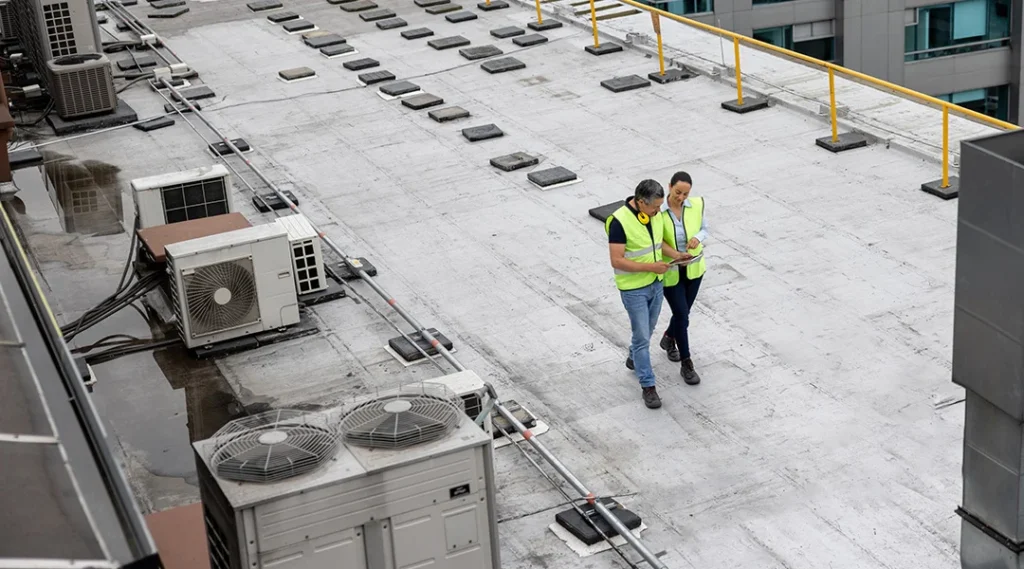
This commercial flat roof maintenance checklist works as a living document. Use it yourself or hand it to a roofing contractor for a formal inspection.
1. Surface and Membrane Inspection
- Walk the entire roof surface looking for blisters, tears, cracks, or bare spots.
- Check for granule loss on modified bitumen sections, which exposes the roof to UV damage.
- Photograph problem areas so you can track changes between inspections.
- Inspect roof edges and parapet walls, where wind uplift most commonly causes separation.
2. Drainage and Ponding Water Check
- Confirm gutters, downspouts, drains, and scuppers are clear of leaves and debris.
- Look for standing water more than 48 hours after rainfall, a sign of a drainage problem.
- Check that overflow drains and scuppers are unobstructed and properly sized.
- Verify the roof’s slope still directs water toward drainage points as designed.
3. Flashing, Seams, and Penetrations
- Inspect flashing around HVAC units, vent pipes, skylights, and access hatches.
- On TPO roofs, gently probe heat-welded seams for weak spots that look intact but lack adhesion.
- On EPDM roofs, check adhesive seams and lap joints, the most common failure point.
- Confirm termination bars and edge metal are tight, aligned, and properly sealed.
4. Structural and Fastener Review
- Check the roof deck for soft spots, sagging, or trapped moisture underneath the membrane.
- Inspect mechanical fasteners for looseness, which increases vulnerability to wind uplift.
- Review support beams and connection points for corrosion or excessive deflection.
5. Seasonal Massachusetts Maintenance Schedule
- Spring: Assess freeze-thaw damage, test drainage capacity, and clear winter debris.
- Summer: Monitor membrane condition during peak heat, when expansion stress is highest.
- Fall: Clear leaves before they clog drains and confirm the roof is storm-ready.
- Winter: Watch for ice damming near parapet walls and excess snow load.
TPO and EPDM Roof Maintenance Tips
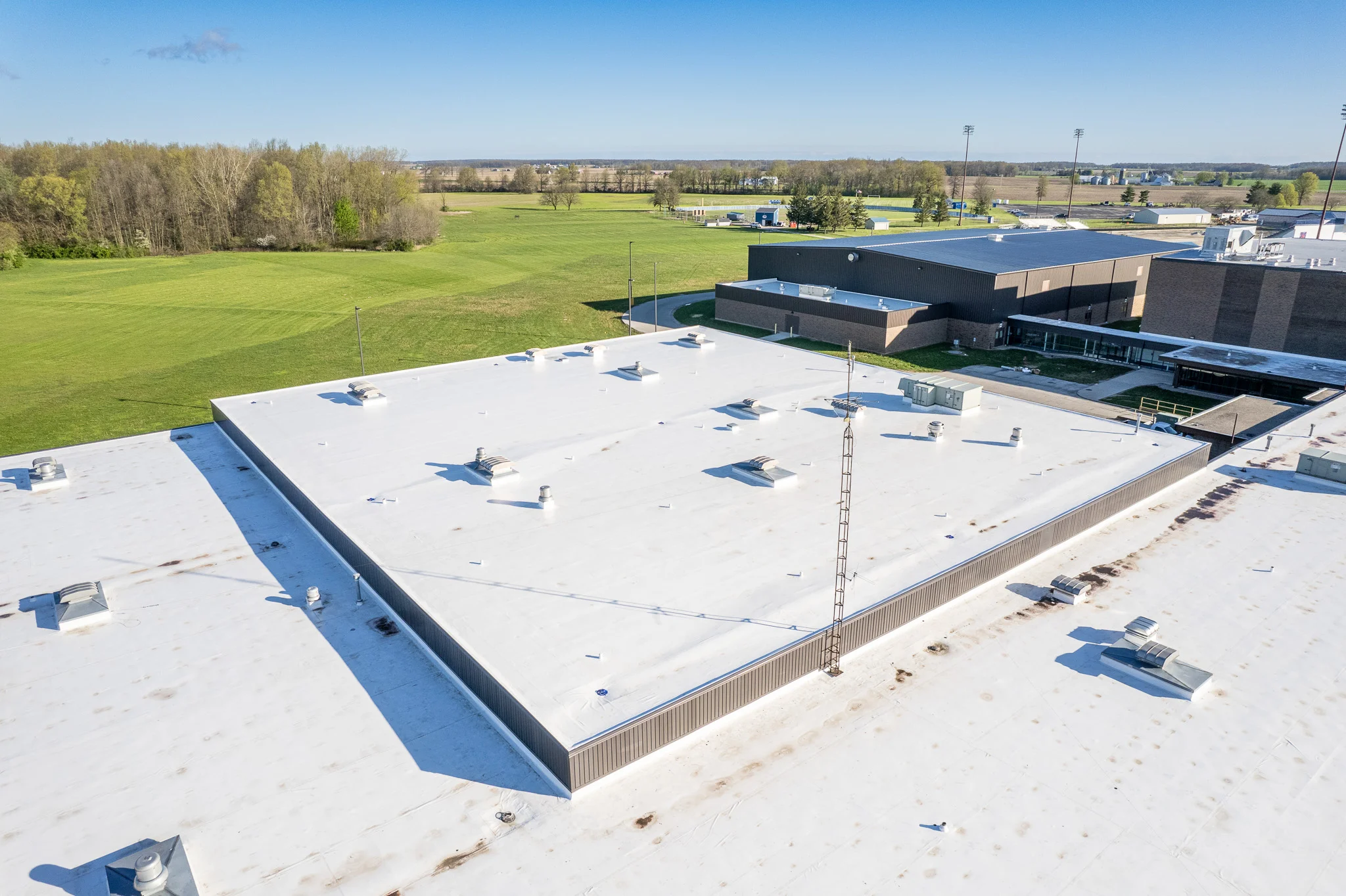
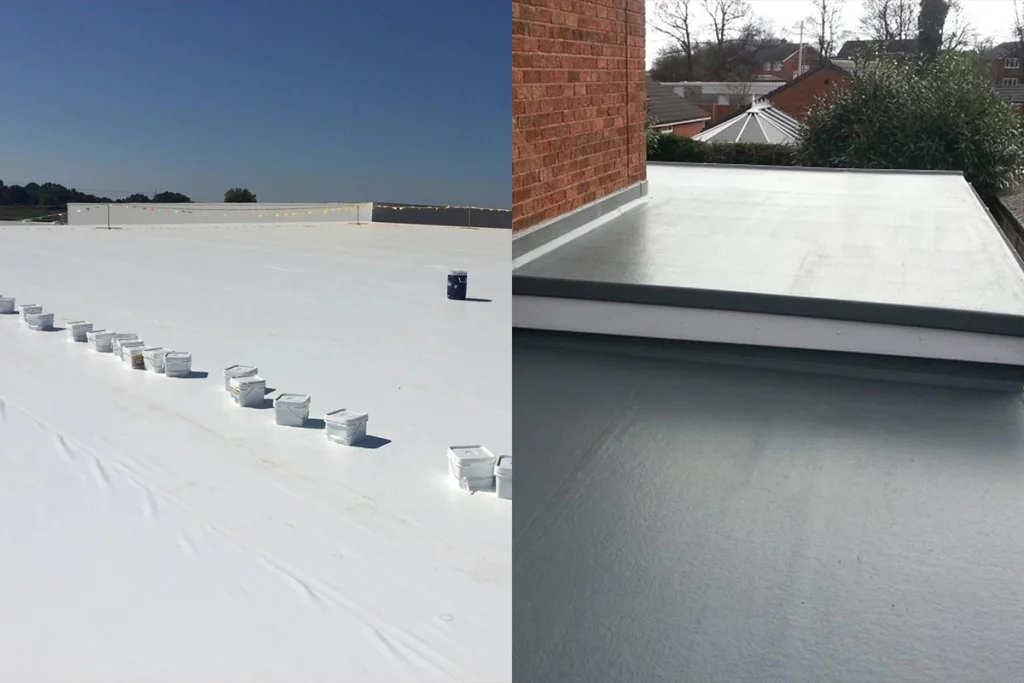
Most commercial flat roofs in Central Massachusetts use TPO or EPDM membranes. Commercial flat roof maintenance looks different depending on which membrane your building has.
TPO Roof Maintenance Tips
- Keep the reflective white surface clean, since dirt buildup reduces energy efficiency.
- Inspect heat-welded seams annually, since a weld can fail internally while still looking sealed.
- Avoid dragging heavy equipment across the surface, which can puncture the membrane.
- Watch for discoloration or staining, which often signals contamination or early degradation.
EPDM Roof Maintenance Tips
- Check adhesive seams every inspection cycle, since they separate more easily than heat-welded seams.
- Look for surface chalking, a white powdery residue that signals UV degradation.
- Reapply protective coatings on schedule, since EPDM benefits from periodic UV protection.
- Clear standing debris quickly, since EPDM’s rubber surface can retain moisture.
Ponding Water on Your Flat Roof: Causes and Fixes
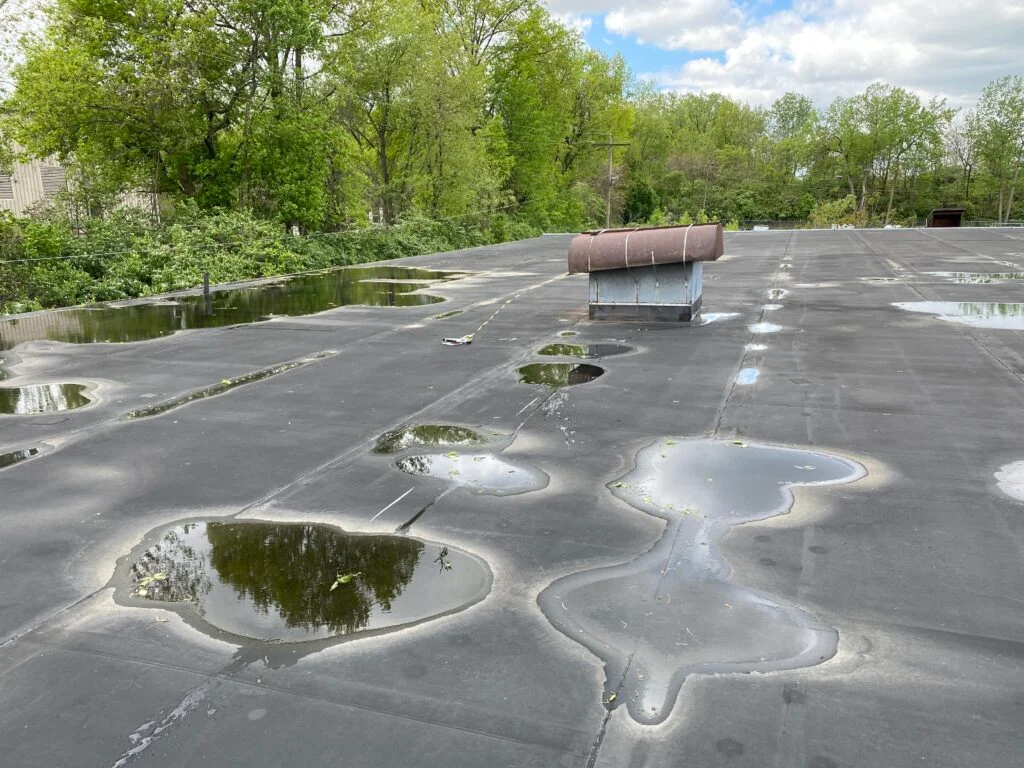
Ponding water is one of the most common, and most misunderstood, issues commercial flat roof maintenance addresses. Industry standards define it as water remaining more than 48 hours after rainfall.
What Causes Ponding Water
- Insufficient roof slope, often from an older design that never accounted for drainage.
- Clogged or undersized drains, scuppers, or gutters.
- Structural settling that creates low spots over time.
- Rooftop equipment installed without accounting for water flow around it.
How Ponding Water Is Fixed
- Tapered insulation systems: Redirect water flow toward drains without a full replacement.
- Additional drains or scuppers: Added at low points where drainage is undersized.
- Regrading or leveling: Corrects minor structural settlement in isolated areas.
- Routine drain clearing: Solves the issue when the cause is simple debris buildup.
Left unaddressed, ponding water accelerates membrane breakdown and adds significant weight to the structure. It also creates conditions that lead to interior leaks and mold growth.
What Commercial Flat Roof Maintenance Costs in Massachusetts
Commercial flat roof maintenance pricing varies by building, so an accurate number requires a physical inspection. Several factors consistently drive maintenance costs up or down.
- Roof size and layout: Larger roofs with many penetrations or HVAC units take longer to service.
- Membrane type and age: Older EPDM systems often need more frequent attention than newer TPO.
- Inspection frequency: A twice-yearly maintenance contract typically costs less per visit than emergency calls.
- Extent of existing damage: Minor sealant touch-ups cost far less than tapered insulation work.
- Accessibility: Roofs with limited access or steep parapet walls can add labor costs.
Because these variables shift the price so much, costs are not quoted sight unseen. A written, itemized proposal for your commercial flat roof maintenance follows a free on-site inspection.
Why Choose Brian M. LeBlanc Roofing
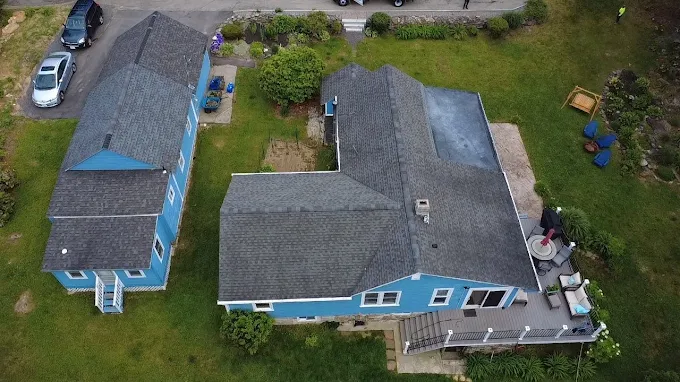
Brian M. LeBlanc Roofing is a GAF Master Elite certified roofing contractor based at 27 Brian M. LeBlanc Roofing is a licensed, insured, GAF-certified roofing company based in Leominster, MA. We serve homeowners and businesses throughout Central Massachusetts and Southern New Hampshire, including Leominster, Fitchburg, Gardner, Lunenburg, Worcester, Marlborough, and surrounding communities.
Here is what separates us from general contractors and national chains:
- Comprehensive roof inspections: Every roofing project begins with a detailed inspection to identify leaks, storm damage, ventilation issues, flashing failures, and other roofing concerns before work begins.
- Dedicated project manager: Every customer is assigned a dedicated project manager who oversees the project from inspection through final walkthrough, providing clear communication and personalized recommendations.GAF-certified roofing expertise: Our team is trained and certified by GAF and follows manufacturer installation standards to build roofing systems designed for long-term performance in New England weather.
- Licensed and insured: We are fully licensed and insured, giving homeowners confidence that every roofing project meets professional and safety standards.
- Industry-leading warranty protection: We install complete GAF roofing systems backed by up to a 50-year limited manufacturer’s warranty and a 10-Year Superior Craftsmanship Guarantee on labor.
- Experienced roofing professionals: Brian M. LeBlanc Roofing has more than 20 years of construction experience, supported by a highly trained team committed to quality workmanship and customer satisfaction.
- Transparent roofing process: From the initial consultation to the final quality inspection, we keep homeowners informed with detailed proposals, project updates, and quality assurance at every step.
Conclusion: Protect Your Roof Before Small Problems Become Expensive Ones
A commercial flat roof rarely fails all at once. It fails one skipped inspection, one clogged drain, and one ignored seam at a time.
Every item on this commercial flat roof maintenance checklist is manageable when caught early, and far more expensive when it is not. Consistent commercial flat roof maintenance protects both your building and your budget.
For more details, connect with us on Facebook, Instagram, YouTube, and Google Business Profile.
Contact us today to schedule your inspection or get a free quote.
Frequently Asked Questions
1. How often should a commercial flat roof be inspected in Massachusetts?
Roofs under 10 years old should be inspected once a year. Roofs 10 years or older need two inspections annually, plus an additional check after any major storm.
2. What is the biggest cause of commercial flat roof failure?
Ponding water is the leading cause of failure. When water sits on the roof for more than 48 hours after rainfall, it accelerates membrane breakdown and can eventually lead to interior leaks.
3. How long should a commercial flat roof last?
A well-maintained TPO or EPDM commercial flat roof typically lasts 20 to 30 years. Skipped or inconsistent maintenance can shorten that lifespan to as little as 12 years.
4. What is the difference between TPO and EPDM roofing maintenance?
TPO roofs require annual checks of heat-welded seams along with regular surface cleaning. EPDM roofs need adhesive seam inspections and periodic UV protective coatings to prevent degradation.
5. How do you fix ponding water on a flat roof?
Common solutions include installing tapered insulation to redirect water flow, adding drains or scuppers, regrading low spots on the roof surface, and keeping drains clear of debris to prevent blockage-related ponding.